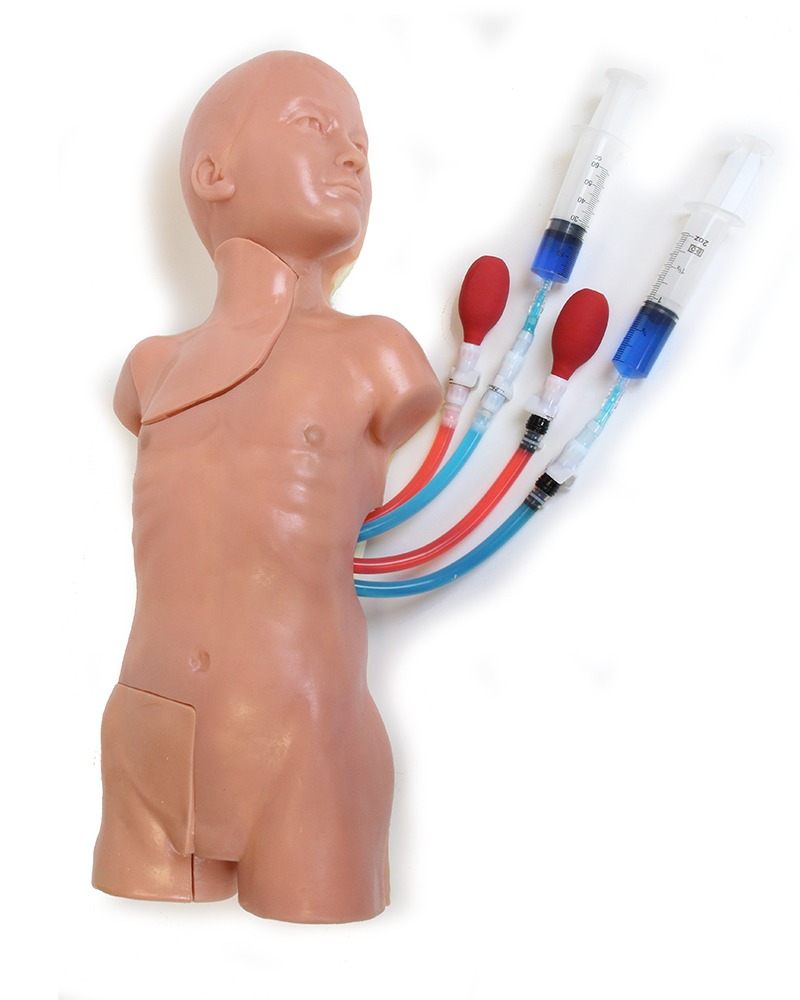
Pediatric Central Line and Femoral Line Insertion Trainer
Prices will show up upon login
The VascularAccessChild is the only high fidelity soft tissue pediatric simulator designed to train central line placement. The trainer offers an effective ultrasound-guided solution for central venous access on a simulated five-year-old child that includes three access sites, replaceable tissues, and ultrasound compatibility during catheter placement.
Simulab has leveraged its highly acclaimed vascular access trainers to meet the unique needs of pediatrics.
Components
:
VascularAccessChild Body Form
Replaceable Neck Tissue (VACN-30)
Replaceable Femoral Tissue (VACF-30)
Vessel Filling Port
Fill Line
Two Pulse Bulbs
Two Venous Pressure Regulators
Carrying Case
Arterial Fluid (red)
Venous Fluid (blue)
User's Guide
Anatomically correct, ultrasound compatible, soft tissue five-year-old, with all relevant difficult palpating landmarks and vascular anatomy
Market leading durability—self-sealing tissues and veins provide the greatest value, in the frequency of needle sticks and full catheterizations per access site, of any trainer on the market
Exceptional ultrasound imaging through repeated use—needle sticks and full catheterizations do not degrade the image acuity
Two colors of simulated blood differentiate the arterial and venous vessels—provides immediate feedback of unsuccessful cannulation
Arterial pulse is present and vein realistically compresses under palpation
Easily adjustable venous pressure regulator allows for vein compression or low-pressure simulation scenarios
Replaceable tissues come pre-filled with blue venous and red arterial fluid. Tissues can remain filled when not in use and are easy to refill with provided fluid when necessary
Portability—practice simulation in settings of actual patient care
Practice full central venous catheterization using ultrasound-guided or blind/landmark insertion approaches at the internal jugular, subclavian, and femoral access sites.
Practice use of ultrasound for:
Developing psychomotor skills required for obtaining visualization during cannulation on pediatric patients
Visualizing arterial pulse and venous compression
Identifying the anatomical location of the target vessel
Visualizing needle cannulation, guidewire threading, and catheter placement
Practice palpating external landmarks to identify vessel location